)
)
)
Beyond the Ping: The Science of Knock Management
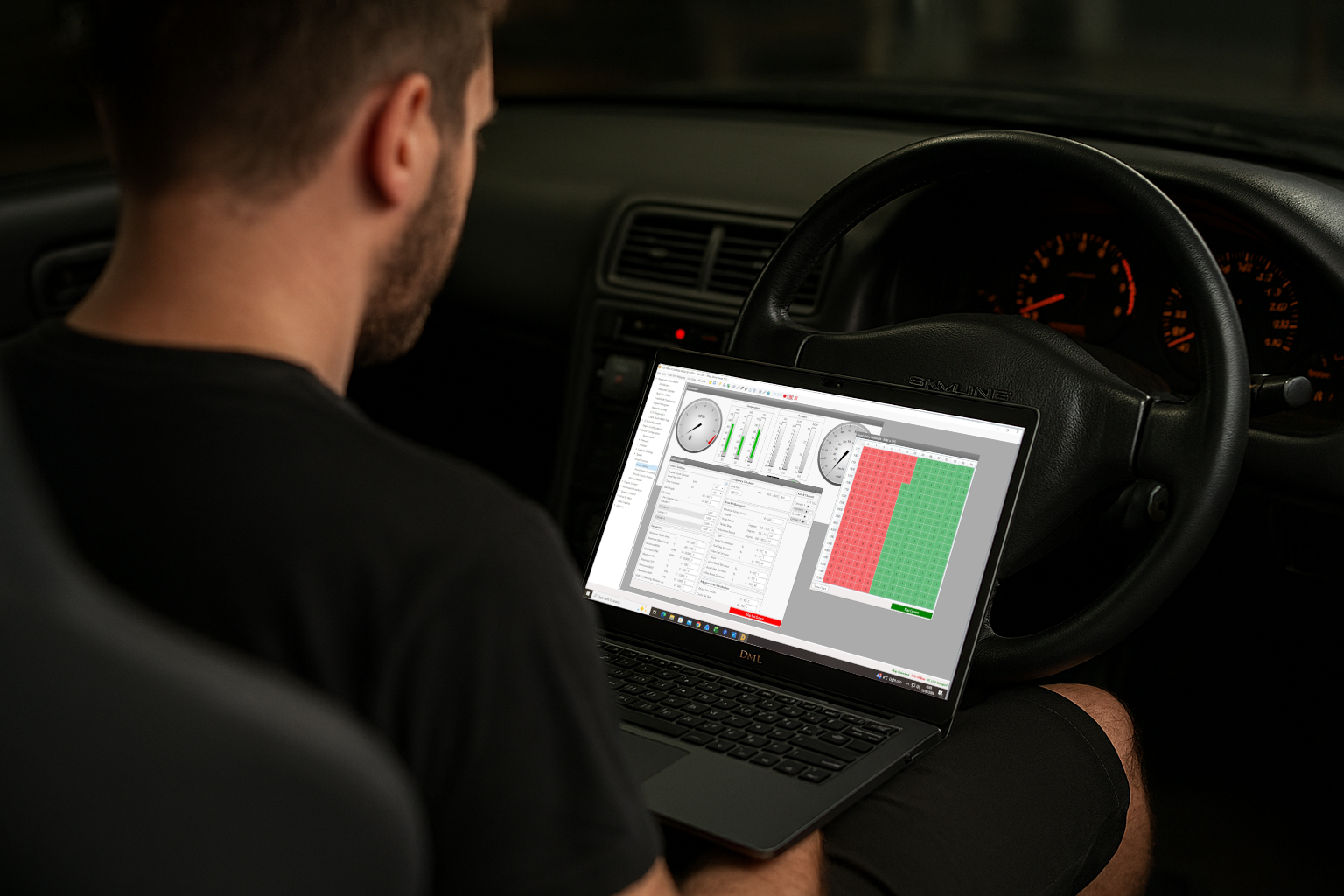
Knock Control
Knock is the audible noise produced when detonation or pre-ignition occurs. This happens when the air-fuel mixture ignites due to heat and cylinder pressure without a spark trigger—similar to the compression-ignition process in a Diesel engine, but far less controlled.
In a normal combustion event, ignition spreads from the spark plug at a consistent rate, filling the chamber and pushing the piston down toward the crankshaft. During pre-ignition, the energy is released almost instantly.
Prevention and Management
Since knock is caused by a combination of heat and high cylinder pressure, we must control these variables. Both fuel and ignition tables are fully mappable within the ECU to prevent these conditions.
What Causes Knock?
Knock can be triggered by several factors, including:
- Low-octane fuel
- Incorrect spark plug heat ranges
- Dirty or blocked injectors
- Vacuum leaks
The most common cause—especially in vehicles stored for long periods—is stale fuel. As fuel components evaporate, the octane rating drops, reducing the fuel's ability to resist detonation. Even if your ECU maps are perfect, these external factors can still cause issues.
Methods of Control
1. Controlling Temperature via Fuel
During engine mapping, it is well-known that a lean Air-Fuel Ratio (AFR) increases combustion chamber temperatures compared to a rich AFR. In extreme cases, excessive heat from a lean mixture can cause vital components to melt, crack, or fracture.
2. Controlling Pressure via Ignition Timing
Over-advanced ignition occurs when the spark plug fires too early. This causes the flame front to fill the combustion chamber and parts of the bore before the piston reaches Top Dead Center (TDC). Because the engine is still in its compression phase, the force of the expanding gases creates massive pressure spikes that trigger detonation. This typically results in premature bearing failure, damaged pistons, or bent connecting rods.
3. Controlling Pressure via Boost
If your T-Series ECU utilizes a boost control solenoid or wastegate, turbo pressure can be decreased in stages. Unlike fuel and ignition timing, boost reduction is a global adjustment and cannot be applied to individual cylinders.
Knock Detection on T-Series ECUs
All "+" models of the T-Series ECUs feature built-in knock monitoring and control, with the T8+ and T12+ offering dual-knock sensing for banked (V-style) engines.
The knock sensor acts as a microphone, sensing specific vibrations and transmitting them to the ECU. Because engines produce various frequencies, you must specify the correct frequency for the ECU to "listen" to.
- Frequency Calculator: The T-Series interface includes a built-in calculator to estimate the knock frequency.
- Fine-Tuning: For definitive setup, record the knock signal and analyse it using software like Goldwave. The calculated frequency may not exactly match the frequency produced.
How the ECU Reacts
Once the T-Series ECU identifies knock, it initiates a strategy to eliminate it. This is done through:
- Ignition Retard: Pulling timing to reduce peak pressure.
- Fuel Enrichment: Adding fuel to individual cylinders to cool the combustion event.
- Boost Reduction: Dropping overall pressure in supported applications.
These adjustments are applied in initial steps until a defined maximum percentage is reached. Once the knock sensor signal stabilizes, the ECU can gradually remove these safety adjustments via the Adjustment Re-introduction settings.
)
)
)
)
)
)
)