)
)
)
Kalle Grunde Interviewl: The Ford RS200, a Golf That Beat Group B Cars and the Rally That Went Very Wrong
There are rally drivers who tell you about their careers. And then there are rally drivers who casually mention driving 8,000 kilometres across Egypt, battling sand dunes and mechanical problems, before explaining that the Ford RS200 was simply the most fun car they ever drove.
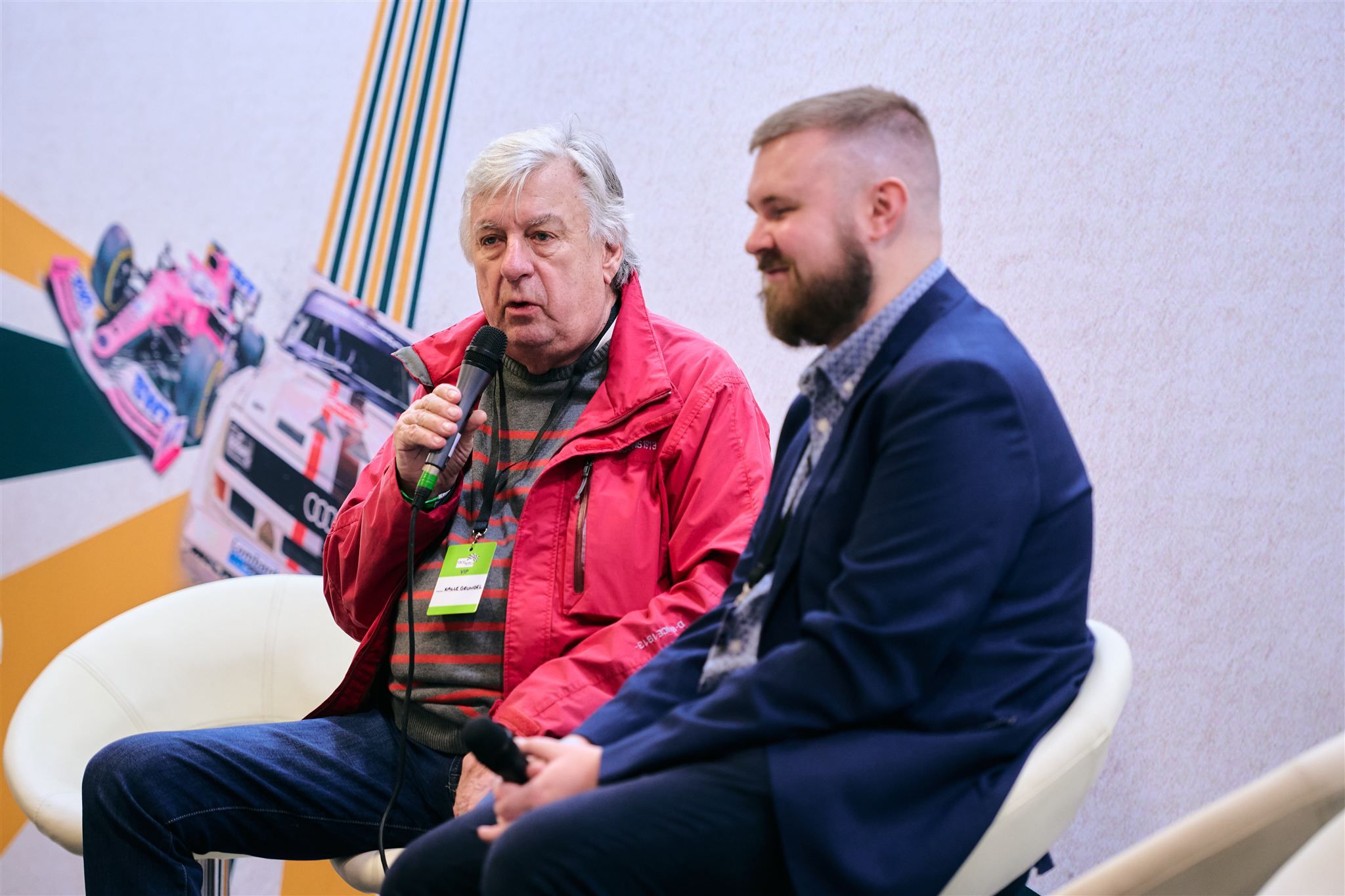
At Race Retro, Swedish rally driver Kalle Grundel joined us on stage to talk about the cars, co-drivers and rallies that shaped his career. There was the Ford RS200, the Volkswagen Golf that nobody seemed to think would work, a WRC podium in Sweden and an Egyptian desert adventure involving sand, broken machinery and dead motorbikers.
In other words, fairly standard rally-driver conversation.
Falling for the Ford RS200Of all the cars Kalle drove during his career, one stood out above the rest: the Ford RS200.
His first experience of the four-wheel-drive Group B car came during a test at Boreham. It didn't take long for him to make up his mind.
He loved it.
For Kalle, the RS200 wasn't simply about outright performance. It was the way the car handled and, crucially, how much fun it was to drive. He described it as outstanding in terms of handling and said it was the car he most enjoyed racing.
And that mattered.
For a rally driver, having confidence in the car underneath you is rather useful when the road is doing its best to throw you into a hedge.
Kalle's enthusiasm for the RS200 was immediate enough that, after driving it at Boreham, he decided he wanted to drive the Ford rather than continue with his previous plans.
From a tuned two-stroker to professional rallyingKalle's route into rallying wasn't some carefully engineered childhood plan to become a factory driver.
It started with a friend and a tuned two-stroke car.
At 18, he became interested in rallying, joined a driving school and quickly obtained his licence. What started as something he enjoyed doing gradually developed into a serious rallying career.
Kalle explained that he never really dreamed of becoming a factory driver. He was simply enjoying rallying and seeing where it took him.
It eventually took him a very long way indeed.
Along the way, he worked with co-drivers from several different countries, including Ireland, Germany and Sweden. He spoke warmly about them, describing them as professional, fun-loving people who shared the same enjoyment of rallying.
Which is probably handy when your working relationship involves sitting beside someone while they drive very quickly through forests.
The Saab 99 Turbo that changed everythingOne of the biggest turning points in Kalle's career came after he crashed his Saab 99 Turbo.
Rather than simply repairing the car and carrying on, he decided to switch direction completely.
The replacement was a Volkswagen Golf.
It wasn't exactly the obvious choice for taking on the established rally cars of the time. Kalle knew that, too. He had to convince the Volkswagen importers in Sweden to support the project, eventually securing four sponsors and beginning his Swedish rally career with the Golf in 1983.
The doubters didn't exactly disappear overnight.
In his first year, Kalle finished fifth overall in the Swedish championship. The performance was strong enough that other teams protested the legality of the Golf.
It seems that when a car starts doing rather better than people expect, paperwork suddenly becomes very interesting.
But the Golf worked.
And Kalle enjoyed driving it.
That combination proved rather effective.
Beating bigger cars with a GolfThe Golf's success was particularly notable because Kalle found himself competing against much more powerful Group B machinery.
The Golf wasn't supposed to be the car that caused problems for those machines. Yet Kalle was able to beat them.
For him, part of the appeal was simply how enjoyable the Golf was to drive. It wasn't just about having the most powerful car. A car that gave the driver confidence and enjoyment could do remarkable things.
It was one of the recurring themes of Kalle's stories at Race Retro: the importance of feeling comfortable and confident in a rally car.
Sometimes, apparently, the answer isn't another 200 horsepower.
Sometimes it's a Golf.
Not every rally car was a favouriteOf course, not every car Kalle drove produced the same level of affection.
When asked if there were any cars he didn't particularly enjoy, he mentioned a Fiat 500 rally car that he drove in Austria.
It was an interesting experience, but a challenging one.
Compared with the RS200, it seems the Fiat left rather less of an impression.
Although perhaps that is an unfair comparison. One is a tiny Fiat and the other is a Group B Ford designed for the sort of driving that makes normal insurance companies nervous.
Kalle Grundel and the modern WRCKalle also gave his thoughts on modern rallying.
His feelings were mixed.
He explained that he doesn't have the same level of interest in the current WRC, finding it somewhat boring and overly complicated. He also pointed to the limited number of manufacturers competing today compared with the variety seen during his career.
For Kalle, part of the appeal of rallying was the variety of cars and the different challenges they presented.
He hopes the WRC can become more diverse and exciting again.
It is a fairly simple wish: more variety, more excitement and fewer reasons to fall asleep while watching the world's best rally drivers.
Sweden, 1986: a WRC podiumOne of Kalle's most memorable achievements came on home territory in the 1986 Swedish Rally.
Kalle and his co-driver Stig produced a strong performance to secure a WRC podium, despite encountering technical problems and a puncture during the rally.
It was another example of the sort of resilience required in rallying. Things don't need to go perfectly for a good result to happen.
Sometimes they just need to go less wrong than everyone else's.
For Kalle, the result remains one of the standout moments of his career.
8,000 kilometres across the Pharaoh RallyThen there was the Pharaoh Rally in Egypt.
Kalle's story of the event was perhaps one of the most remarkable moments of the interview.
The rally covered around 8,000 kilometres over eight days, with Kalle joined by co-driver Sapo and mechanic Timus.
It was not exactly a gentle introduction to desert rallying.
Kalle described driving through the Egyptian desert, dealing with huge sand dunes and mechanical problems along the way. The environment itself presented challenges that simply don't exist when you're rallying through a European forest.
There were also moments when the reality of desert rallying became particularly stark. Kalle recalled encountering dead motorbikers during the event.
Despite the setbacks, Kalle and his crew managed to keep going. He recalled finishing just 15 minutes behind Ari, while winning every stage from the second day onwards.
The experience was difficult, demanding and, by the sounds of it, completely unforgettable.
He spoke about the Pharaoh Rally as an enormous learning experience and an adventure he was glad to have experienced.
Although, having heard the story, it is perhaps understandable why he also described elements of desert rallying as terrifying.
A career built on cars that were fun to driveListening to Kalle Grundel talk about his career, one thing comes through clearly: the cars mattered.
Not simply because they were fast, powerful or technically impressive, but because of how they felt from behind the wheel.
The Ford RS200 remained his favourite because of its handling and sheer enjoyment. The Volkswagen Golf proved that an unlikely car could take on much more powerful opposition. And the Pharaoh Rally demonstrated just how far a rally car — and its crew — could be pushed.
From a tuned two-stroker at 18 to a WRC podium in Sweden and thousands of kilometres across the Egyptian desert, Kalle's career is packed with the sort of stories that make rallying so fascinating.
And fortunately, at Race Retro, he was happy to tell them.
Watch this space for more interviews and stories from the world of classic motorsport at Race Retro.
)
)
)
)
)
)
)